












Evolution of Computers
Learn the evolution of computers in simple words. See the five generations, key inventions, a clear timeline, and what comes next with AI and quantum computing.

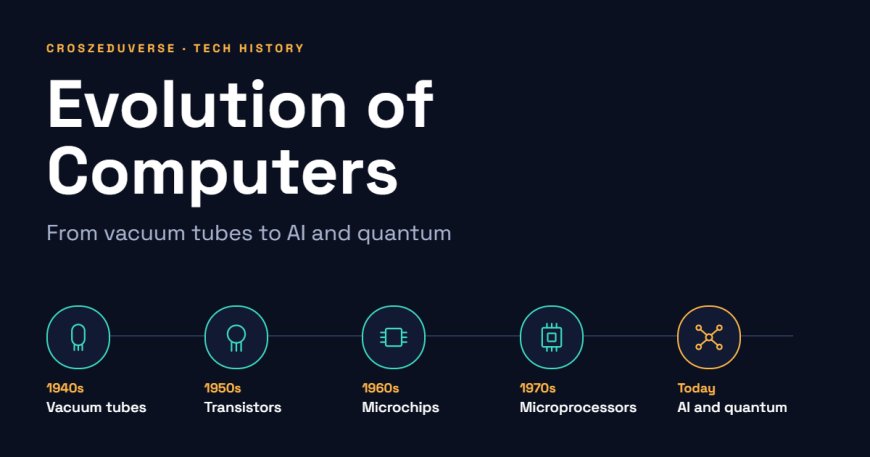
The phone in your pocket is far more powerful than the room-sized machines that first appeared in the 1940s. How did we get from huge, hot machines to tiny, smart devices? In this guide from Croszeduverse, we explain the evolution of computers in simple words, step by step.
What Is the Evolution of Computers? (Quick Answer)
The evolution of computers is the story of how calculating machines changed over time. They began as simple tools and giant electronic machines. Today they are small, fast, and smart devices. Each big step made computers smaller, faster, cheaper, and easier to use.
People usually split this story into five generations of computers, based on the main technology each one used.
Before Electronic Computers: The Early Ideas
Long before electricity, people needed help with maths. Here is how it started:
- The abacus: a simple counting tool used for thousands of years.
- 1623: Wilhelm Schickard built one of the first mechanical calculating machines.
- 1642: Blaise Pascal built the Pascaline, a machine that could add and subtract.
- 1837: Charles Babbage designed the Analytical Engine. It was never finished, but it had ideas we still use today, like a memory and a processor.
- 1843: Ada Lovelace wrote notes that included a step-by-step method for the machine. Many people call it the first computer program.
That is why Babbage is often called the "father of the computer" and Lovelace is seen as the first programmer.
The Five Generations of Computers at a Glance
|
Generation |
Years (approx.) |
Main Technology |
Examples |
Key Features |
|---|---|---|---|---|
|
First |
1940s–1950s |
Vacuum tubes |
ENIAC, UNIVAC |
Huge, hot, costly, machine language |
|
Second |
1950s–1960s |
Transistors |
IBM 1401 |
Smaller, faster, more reliable |
|
Third |
1960s–1970s |
Integrated circuits (ICs) |
IBM System/360 |
Cheaper, operating systems |
|
Fourth |
1970s–today |
Microprocessors |
Apple II, IBM PC |
Personal computers, networks |
|
Fifth |
Today and future |
AI, parallel processing |
Smartphones, AI tools, supercomputers |
Smart, connected, learns from data |
Note: Books and teachers sometimes use slightly different dates for each generation. The main idea is always the same: better parts made better computers.
First Generation (1940s–1950s): Vacuum Tubes
The first electronic computers used vacuum tubes, which are glass tubes that control electric current. These machines filled whole rooms. They used a lot of power, made a lot of heat, and often broke down.
Important machines from this time:
- Z3 (1941): built by Konrad Zuse in Germany, it is seen as the first working programmable computer.
- Colossus (1943–44): used in Britain during World War II to help break secret codes.
- ENIAC (1946): a famous early electronic computer in the United States.
- UNIVAC (1951): one of the first computers sold to businesses.
These computers used machine language, which is just 0s and 1s. Programming was slow and hard.
Second Generation (1950s–1960s): Transistors
In 1947, the transistor was invented at Bell Labs. It did the same job as a vacuum tube but was much smaller, cooler, and more reliable.
What changed:
- Computers became smaller and faster.
- They used less power.
- Programmers could use assembly language and early languages like FORTRAN and COBOL.
- Businesses and schools began to use computers more.
The IBM 1401 is one of the best-known computers of this time.
Third Generation (1960s–1970s): Integrated Circuits
In 1958, Jack Kilby showed the first integrated circuit (IC, also called a microchip). An IC puts many tiny parts on one small piece of silicon.
This gave us:
- Even smaller and cheaper computers
- Better speed and memory
- Real operating systems, so one machine could run several tasks
- Famous machines like the IBM System/360 (1964)
In 1965, Gordon Moore noticed that the number of parts on a chip kept doubling. This idea became known as Moore's Law, and it guided the chip industry for decades.
Fourth Generation (1970s–Today): Microprocessors and Personal Computers
In 1971, Intel released the 4004, the first commercial microprocessor. It put the "brain" of a computer on a single chip. This made it possible to build small computers for homes and offices.
Key moments:
- 1977: the Apple II brought computers into homes and small businesses.
- 1981: the IBM PC set a standard for personal computers.
- 1984: Apple's Macintosh made the graphical user interface (icons, windows, and a mouse) popular.
- 1985: Microsoft Windows launched and brought a friendlier screen to many PCs.
- Late 1980s–early 1990s: the World Wide Web was created, and the internet began to connect people everywhere.
- 2007: the iPhone changed phones into pocket computers.
This is the generation that put a computer in almost every home, school, and pocket.
Fifth Generation (Today and Beyond): AI and Smart Computing
The fifth generation is still being written. Its focus is artificial intelligence (AI), which means computers that can learn, understand speech, and help make decisions.
What we see today:
- AI on everyday devices: phones, tablets, and laptops can now run AI tools right on the device, not only in the cloud.
- AI assistants and agents: computers that can finish small tasks for us.
- Cloud computing: powerful computers you can use over the internet.
- Supercomputers: huge machines that help with weather, medicine, and science.
What Is Next? Quantum Computing
Normal computers use bits, which are either 0 or 1. Quantum computers use qubits, which can hold more than one state at the same time. This may help them solve some very hard problems much faster, such as designing new medicines and materials.
Quantum computers are still early. IBM has said it expects 2026 to be the first time a quantum computer beats regular computers on a real problem. Because this field changes fast, check the latest news for updates.
Computer Evolution Timeline (Quick View)
- 1623: First mechanical calculating machine
- 1837: Babbage designs the Analytical Engine
- 1941: Zuse's Z3
- 1946: ENIAC
- 1947: Transistor invented
- 1958: First integrated circuit
- 1971: First microprocessor (Intel 4004)
- 1977: Apple II
- 1981: IBM PC
- 1985: Windows launches
- 2007: iPhone
- 2020s: AI everywhere, quantum computers improving
How Computers Changed Our Lives
- Education: online classes, learning apps, and free knowledge for all.
- Work: emails, video calls, and remote jobs.
- Health: faster tests, better scans, and smarter research.
- Business: online shops, mobile money, and digital banking.
- Daily life: maps, music, photos, and staying in touch with family.
Frequently Asked Questions
Who invented the first computer?
No single person invented it. Charles Babbage designed the first general-purpose mechanical computer idea. Konrad Zuse built the first working programmable computer (Z3, 1941). ENIAC was a famous early electronic computer.
What are the five generations of computers?
They are: (1) vacuum tubes, (2) transistors, (3) integrated circuits, (4) microprocessors, and (5) AI and smart computing.
How did computers get smaller?
Better parts. Vacuum tubes were replaced by transistors, then by chips with thousands, millions, and now billions of tiny parts.
What will computers look like in the future?
Expect smarter, more personal devices that run AI, plus new types of machines like quantum computers for special jobs.
Conclusion
The evolution of computers shows a clear pattern: every generation became smaller, faster, cheaper, and easier to use. From vacuum tubes to microchips to AI, each step opened new doors for learning, work, and creativity. The next chapter may be the most exciting yet.
What do you think the next big step in computing will be? Share your thoughts in the comments, and keep exploring with Croszeduverse.
What's Your Reaction?