



















Where Does the Internet Come From? How the Internet Works Explained Simply
Where does the internet come from? This beginner-friendly guide explains how the internet works, where data comes from, how it travels through cables, servers, and ISPs to your device.


Most of us use the internet every day. We browse websites, send WhatsApp messages, watch YouTube, use Google, and scroll social media. But if someone asked you a simple question like “Where does the internet actually come from?” many people would struggle to explain it.
Some think the internet comes from satellites. Others think it’s “in the air” or stored in the cloud somewhere. The truth is more interesting, and once you understand it, the internet suddenly makes a lot more sense.
Let’s break it down slowly and clearly.
First Things First: The Internet Is Not One Place
The internet is not a building, not a single machine, and not owned by one company.
The internet is a global network of connected computers that communicate with each other using cables, routers, and agreed-upon rules.
In simple terms:
The internet is millions of computers around the world connected together.
So Where Does the Internet Actually Start?
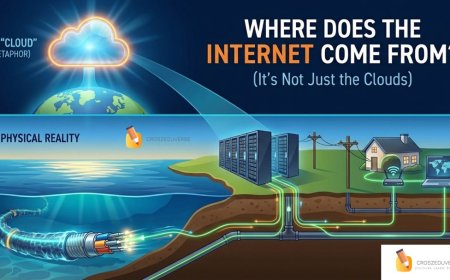
The internet starts from data centers and servers.
What Is a Server?
A server is a powerful computer that stores:
-
Websites (like Google, Facebook, Wikipedia)
-
Videos (YouTube, Netflix)
-
Emails
-
Online apps and systems
For example:
-
Google’s website lives on Google servers
-
Facebook lives on Meta servers
-
Your emails live on mail servers
These servers are kept inside large buildings called data centers.
Data Centers: The Real “Home” of the Internet
Data centers are physical buildings full of:
-
Powerful computers (servers)
-
Cooling systems
-
Backup power (generators)
-
Security systems
They are located all over the world in countries like:
-
USA
-
Germany
-
Kenya
-
South Africa
-
Japan
When you type a website address, your request travels to a data center somewhere, and the server sends the information back to you.
How Does the Internet Travel Across the World?
Here’s the part that surprises most people.
The Internet Uses Cables, Not Magic
Over 95% of the world’s internet traffic travels through cables, not satellites.
These include:
-
Fiber-optic cables underground
-
Fiber-optic cables under the ocean (submarine cables)
Yes, the internet goes under the sea.
Submarine Cables: The Backbone of the Internet
Submarine cables are massive fiber-optic cables laid on the ocean floor connecting continents.
For example:
-
Africa is connected to Europe
-
Europe to America
-
Asia to the rest of the world
These cables carry light signals at nearly the speed of light, allowing:
-
Video calls
-
Streaming
-
Instant messaging
Without these cables, the modern internet would not exist.
What Role Does Your Internet Service Provider (ISP) Play?
Your ISP is the company that connects you to the global internet.
Examples:
-
Safaricom
-
Airtel
-
MTN
-
Verizon
-
Vodafone
Your ISP:
-
Connects to global internet cables
-
Receives internet data
-
Sends it to your home, office, or phone
They act as the middle bridge between you and the internet.
How Does Internet Reach Your Home or Phone?
Let’s simplify the journey.
Step-by-Step Internet Journey
-
You type a website (example: google.com)
-
Your device sends a request to your ISP
-
The ISP sends the request through fiber cables
-
The request reaches Google’s server
-
Google’s server sends data back
-
The data travels through cables again
-
It reaches your phone or computer
-
You see the website
All this happens in milliseconds.
What About Wi-Fi and Mobile Data?
Wi-Fi and mobile data do not create the internet. They only help you access it.
-
Wi-Fi connects your device to a router
-
The router connects to your ISP
-
Mobile data connects your phone to cell towers
-
Cell towers connect to fiber cables
So even wireless internet still ends up using cables somewhere.
Is the Internet Stored in the Cloud?
The “cloud” is not floating in the sky.
The cloud simply means:
Data stored on servers in data centers that you access through the internet.
Your photos, emails, and files are stored on physical computers somewhere in the world.
Who Controls the Internet?
No single person or company controls the internet.
Instead:
-
Different organizations manage standards
-
Governments regulate local access
-
Companies own their own servers
-
ISPs manage connections
This is why the internet keeps working even if one company goes down.
Why Understanding This Matters
Knowing where the internet comes from helps you:
-
Understand internet speeds
-
Troubleshoot network problems
-
Learn networking and IT basics
-
Appreciate how global technology works
It also helps students, businesses, and everyday users make better technology decisions.
Conclusion
The internet doesn’t come from the air, satellites alone, or a single company. It comes from a massive global system of servers, data centers, fiber-optic cables, and internet service providers, all working together to deliver information to you in seconds.
Every time you open a website, send a message, or stream a video, your data is traveling across countries, oceans, and networks all in the blink of an eye.
Understanding this is the first step toward becoming truly tech-savvy.
What's Your Reaction?